Short answerThe Pimax Crystal Light is the VR headset to buy for sim racing on a strong PC: 2880 x 2880 pixels per eye, 35 pixels per degree, 120 Hz and a native DisplayPort link for $859 on store.pimax.com on Nov 21, 2026. It weighs 815 g and needs a cable to the PC; a Meta Quest 3 is lighter, wireless-capable and $259 cheaper, with a softer picture.
 By Reid Castellano, editor · Updated November 21, 2026 · How we rate
Who it's for, and who should skip it
Buy it if
- You race seated in a cockpit and want to read the dash and spot braking boards far down the track
- You have a gaming PC with a DisplayPort 1.4a output and a recent graphics card
- You do not want to set up base stations: tracking is inside-out
Skip it if
- You want one headset for standalone games and fitness too: that is a Quest 3
- Your PC struggles at 1440p on a monitor: it will not drive two 2880 x 2880 panels
- Weight on your head bothers you: 815 g is 300 g more than a Quest 3
The verdict in three lines
- 35 PPD is 40% sharper than a Quest 3 at 25 PPD, and in a race car sharpness is what you feel first.
- DisplayPort means no video compression, and inside-out tracking means nothing to mount on the walls.
- The catch: 815 g, a tethered cable, and a PC that can feed it.
Specs, with units and source
| Spec | Pimax Crystal Light |
|---|---|
| Resolution | 2880 x 2880 per eye |
| Pixels per degree | 35 PPD |
| Refresh rate | 120 Hz |
| Weight | 815 g (1.8 lb) |
| Field of view | 110° horizontal |
| Panel | QLED with mini-LED local dimming |
| Tracking | Inside-out, 4 cameras (Lighthouse faceplate optional, $199) |
| Connection | DisplayPort 1.4a and USB 3.0 |
| Works with | PC |
Which consoles does it work with?
The Crystal Light is a PC headset. It connects through DisplayPort 1.4a and USB 3.0 with its own power adapter and runs through Pimax Play and SteamVR. It does not work with PlayStation or Xbox consoles and has no standalone mode.
Does it work in a cockpit?
A headset changes what you need from the cockpit. You no longer need a monitor stand, which saves floor space and money, and any rig in our ranking works. What matters is cable routing: bring the cable over your shoulder or from a ceiling hook so it does not catch the wheel.
Inside-out tracking uses four cameras on the headset. In a dark room the cameras have less to see, so keep some light on behind the rig.
What's in the box, and what you'll add
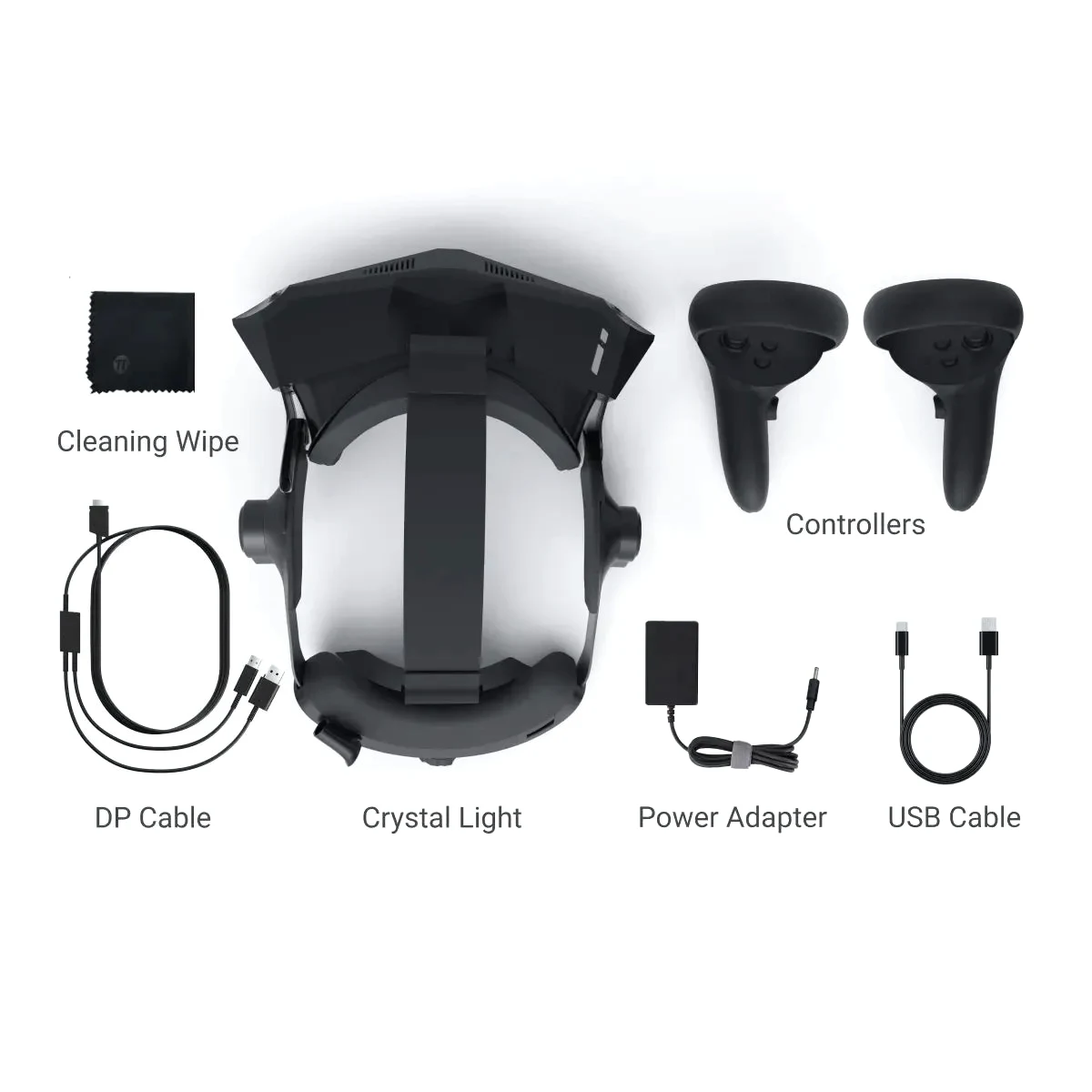
- Headset
- Two controllers
- DisplayPort and USB cable
| You will also need | Cost | Note |
|---|---|---|
| Lighthouse faceplate, optional | $199 | On store.pimax.com on Nov 21, 2026, for SteamVR base station tracking |
| Prescription lens inserts, optional | varies | Offered by third parties; Pimax sells bundles with them |
| A PC that can run it | what you own | A DisplayPort 1.4a output is required |
Compared with a triple monitor setup, a headset removes three screens and a stand from the budget. Compared with a single TV you already own, it adds $859.
Pimax Crystal Light or Meta Quest 3 for sim racing?
| Spec | 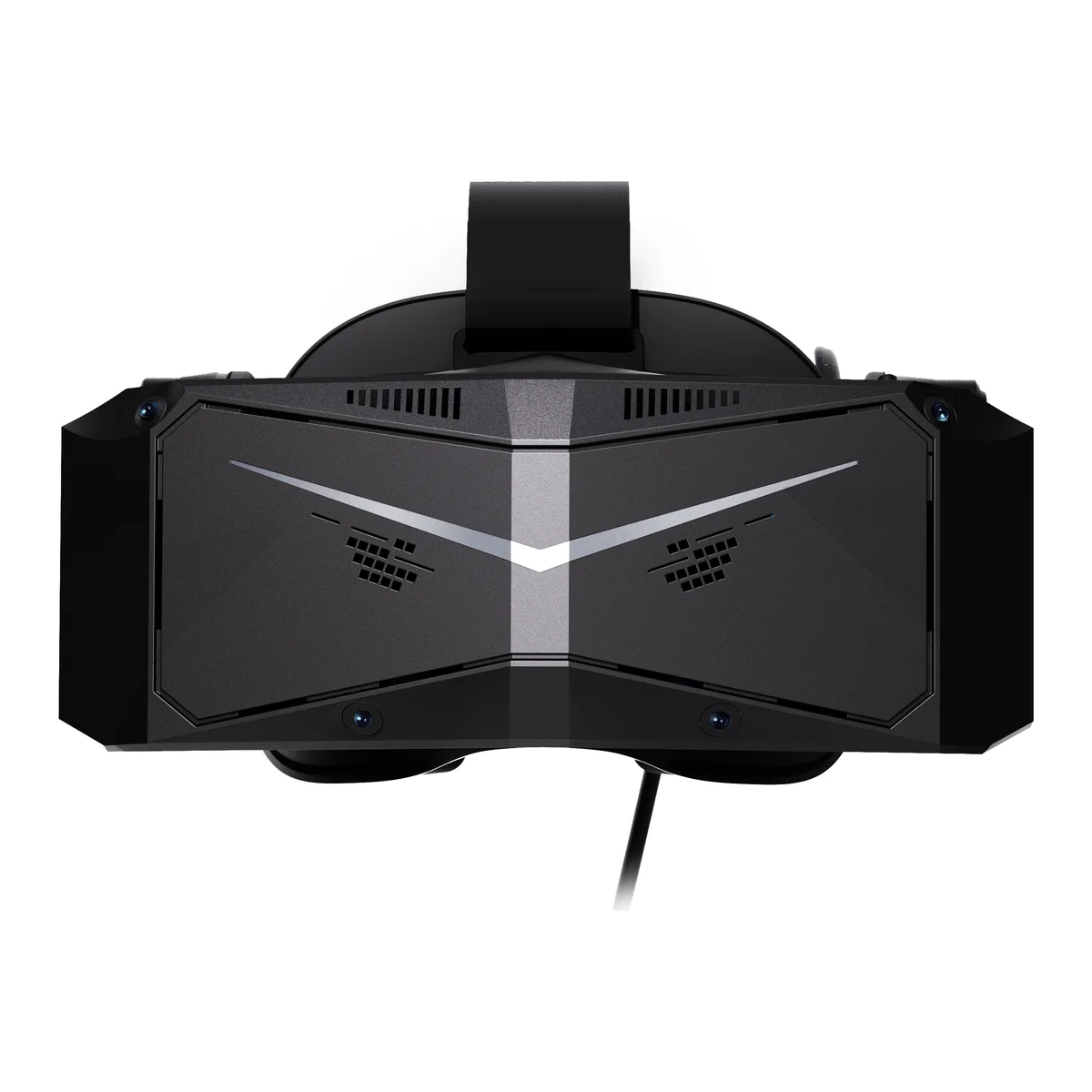 Pimax Crystal Light | 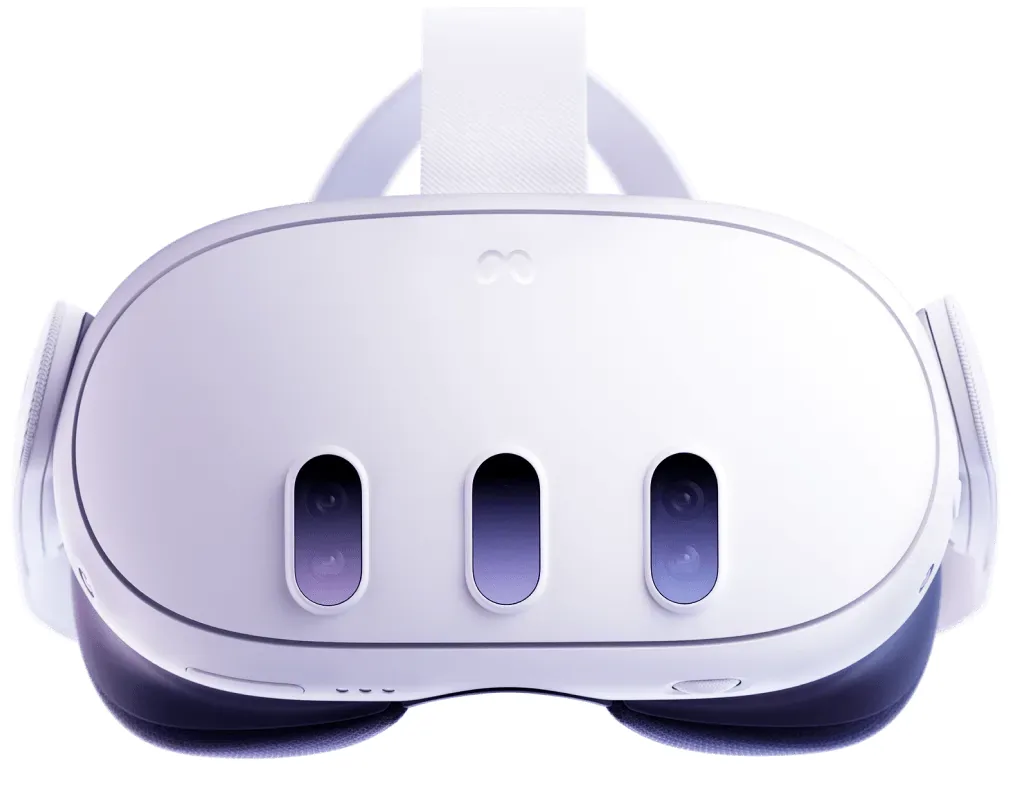 Meta Quest 3 |
|---|---|---|
| Score | 9.1/10 | Not rated yet |
| Price | $859 on Nov 21, 2026 | $599.99 on Nov 21, 2026 |
| Resolution | 2880 x 2880 per eye | 2064 x 2208 per eye |
| Pixels per degree | 35 PPD | 25 PPD |
| Refresh rate | 120 Hz | 120 Hz |
| Weight | 815 g (1.8 lb) | 515 g (1.1 lb) |
| Field of view | 110° horizontal | 110° horizontal |
| Panel | QLED with mini-LED local dimming | LCD |
| Tracking | Inside-out, 4 cameras (Lighthouse faceplate optional, $199) | Inside-out |
| Connection | DisplayPort 1.4a and USB 3.0 | Standalone, USB-C or Wi-Fi link to a PC |
| Works with | PC | Standalone, PC via Link |
| Buy | Check price at Pimax | Check price at Amazon |
The Quest 3 is the better all-round headset and the better deal. The Crystal Light is the better racing headset. In a cockpit you sit still, you look far ahead, and you read small text on a dash, so pixels per degree matter more than weight or wireless freedom. The Pimax has 35 PPD and local dimming for night races; the Quest 3 has 25 PPD and an LCD panel.
If you race twice a month, buy the Quest 3 and enjoy everything else it does. If the rig is where you spend your evenings, the Pimax is the one built for it.
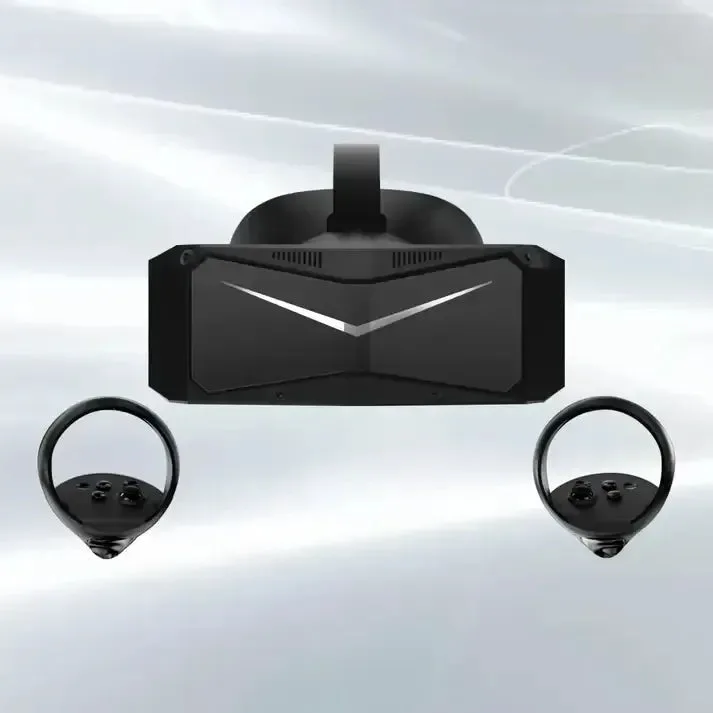
What PC do you need?
Pimax requires a DisplayPort 1.4a output; its own FAQ warns that laptop adapters must support that specification. Beyond the port, the load is simple arithmetic: two 2880 x 2880 panels are 16.6 million pixels per frame, twice a 4K monitor, at up to 120 times a second. Pimax includes fixed foveated rendering to lighten that, and the refresh rate can be set to 72, 90 or 120 Hz.
Is the weight a problem in long races?
At 815 g it is one of the heavier consumer headsets; a Quest 3 is 515 g. Seated and looking forward, weight matters less than in room-scale games. For stints over an hour, plan breaks. Read the health and safety warnings Pimax ships with the headset, in particular on motion sickness and photosensitivity, and stop if you feel unwell.
What we could not confirm
- A minimum graphics card: Pimax does not give one on the store page we read.
- How long the $859 price lasts; $899 is the list price shown.
- Availability of the cheaper version without local dimming: it was listed at $699 and unavailable on Nov 21, 2026.
How it compares with close rivals
| Spec | Pimax Crystal Light | Meta Quest 3 |
|---|---|---|
| Score | 9.1/10 | Not rated yet |
| Price | $859 on Nov 21, 2026 | $599.99 on Nov 21, 2026 |
| Resolution | 2880 x 2880 per eye | 2064 x 2208 per eye |
| Pixels per degree | 35 PPD | 25 PPD |
| Refresh rate | 120 Hz | 120 Hz |
| Weight | 815 g (1.8 lb) | 515 g (1.1 lb) |
| Tracking | Inside-out, 4 cameras (Lighthouse faceplate optional, $199) | Inside-out |
| Connection | DisplayPort 1.4a and USB 3.0 | Standalone, USB-C or Wi-Fi link to a PC |
| Buy | Check price at Pimax | Check price at Amazon |
Price on November 21, 2026
Pimax listed the Pimax Crystal Light at $859 on November 21, 2026. Prices change, sometimes within the week, so the button shows today's price at the seller.
Full spec sheet
| Spec | Pimax Crystal Light |
|---|---|
| Resolution | 2880 x 2880 per eye |
| Pixels per degree | 35 PPD |
| Refresh rate | 120 Hz |
| Weight | 815 g (1.8 lb) |
| Field of view | 110° horizontal |
| Panel | QLED with mini-LED local dimming |
| Tracking | Inside-out, 4 cameras (Lighthouse faceplate optional, $199) |
| Connection | DisplayPort 1.4a and USB 3.0 |
| Works with | PC |
| Warranty | 1 year (Pimax) |
| Sold by | Pimax |
Questions buyers ask
Is the Pimax Crystal Light good for sim racing?
Yes, on a strong PC. Its 35 pixels per degree and DisplayPort link give a sharper picture than a Quest 3, which helps you read the dash and see distant corners.
What is the resolution of the Pimax Crystal Light?
2880 x 2880 pixels per eye on QLED panels with mini-LED local dimming, at 72, 90 or 120 Hz.
Does the Pimax Crystal Light need base stations?
No. It uses inside-out tracking with four cameras. A Lighthouse faceplate is sold separately ($199 on Nov 21, 2026) if you prefer base stations.
Pimax Crystal Light vs Quest 3: which is better?
For seated sim racing on PC, the Crystal Light is sharper (35 PPD against 25 PPD). For everything else, the Quest 3 is lighter (515 g), standalone and cost $599.99 on Amazon on Nov 21, 2026.
Keep comparing
Scores come from a public formula applied to maker-published specs and dated prices. Some links are affiliate links; see the affiliate disclosure.